Go Back
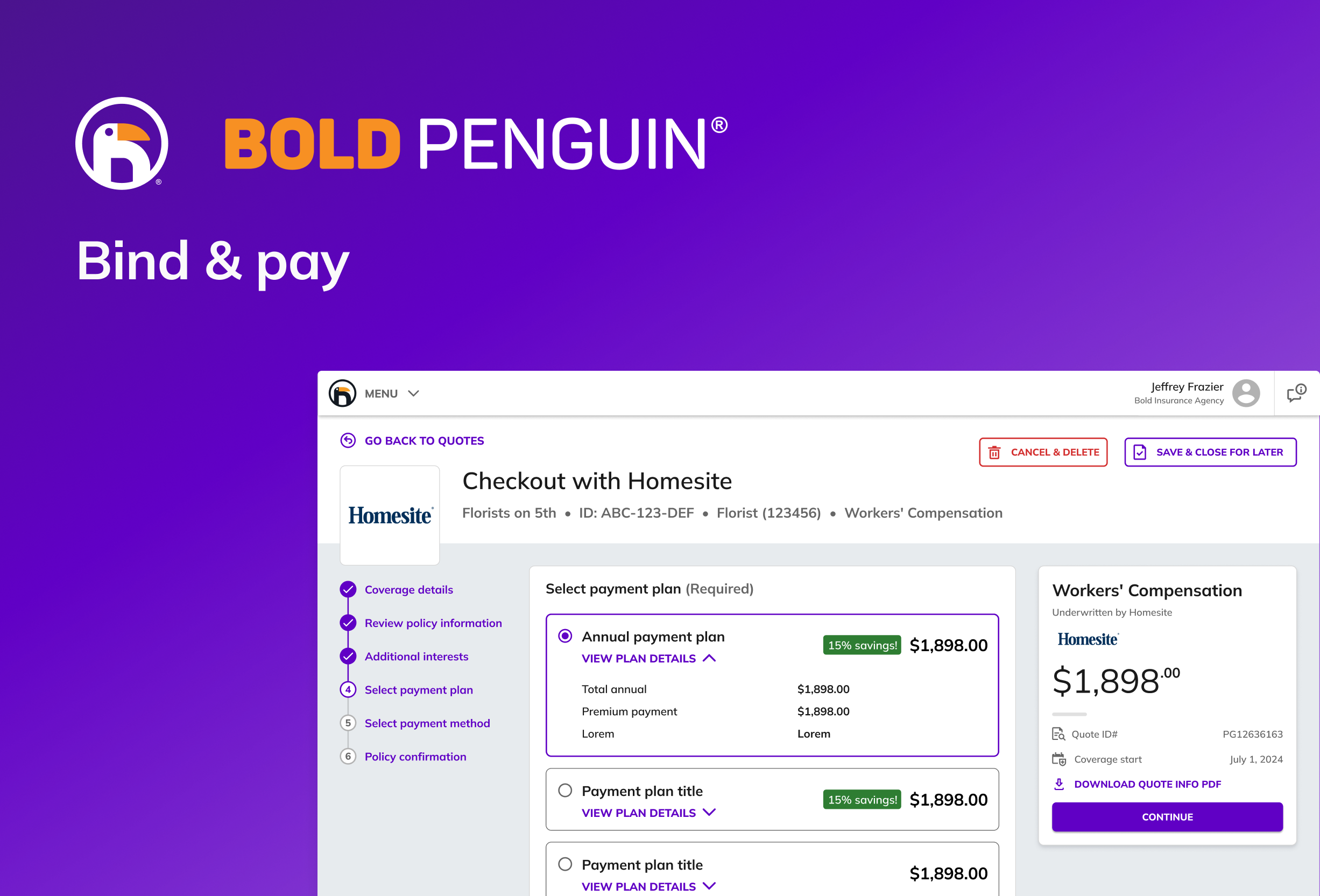
Final Result Preview
Letting commercial insurance agents buy a policy without leaving Terminal
Role: Senior Product Designer on a three-person design team
Ownership: Led the Quote Presentation (Shelf page) redesign; started the Checkout design, then handed it to our Lead Product Designer; designed the payment flow variations for each carrier
Team: Product Manager, Director of Product, two engineering teams, one customer delivery team
Timeline: Q3 and Q4 2024, with V1 planned for enterprise customers in Q2 2025
Problem & Context
Problem Statement
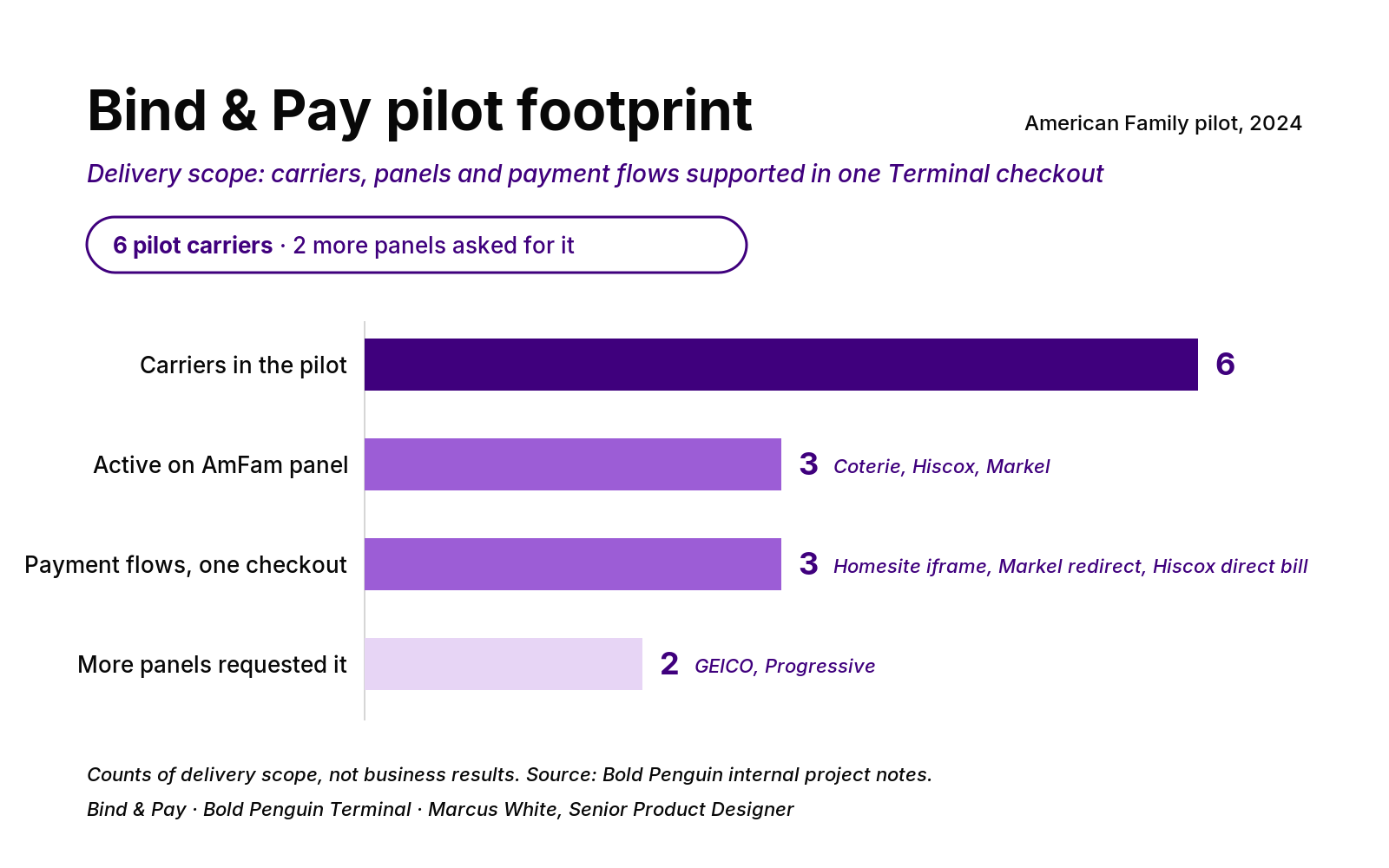
Agents got multiple quotes in Terminal but had to bridge out to each carrier's own portal to buy the policy. Bold Penguin had a contractual commitment to American Family Insurance to bring buying into Terminal, piloting with six carriers (Homesite, Chubb, Coterie, Hiscox, Liberty Mutual and Markel), with Homesite as the featured quote. Three questions opened the work: how Quote Presentation had to change, whether agents could buy several quotes at once, and whether Terminal would collect payment at all.
I framed the problem from the agent's side: agents could quote in Terminal but had to leave it to buy, which broke the workflow just as they were ready to bind
Opportunity Solution Tree
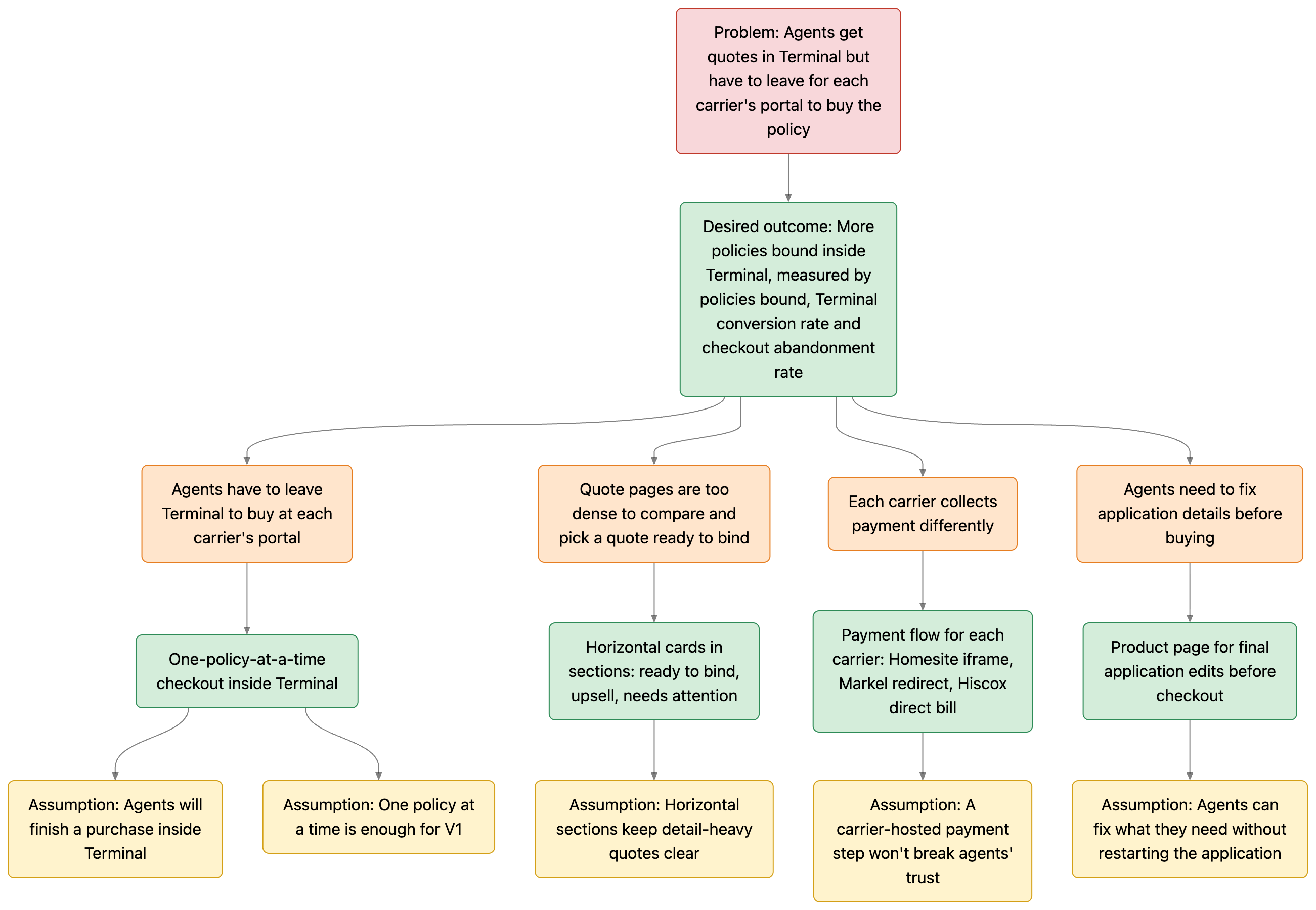
As with Real-time quote eligibility, rename this "Key questions and options" rather than backfilling a tree. The options were a shopping cart versus buying one policy at a time, dedicated product pages versus the existing tabs, editing the application in a modal versus a full page, and grid cards versus horizontal cards for quotes.
I mapped where agents dropped out of the purchase journey and tied each opportunity to the outcome of binding inside Terminal.
The Solution Chosen to Pursue
A one-policy-at-a-time purchase flow inside Terminal that runs from Quote Presentation to a product page for final edits, then Checkout for the payment plan and legal acknowledgments, then a policy-bound confirmation with the policy number, agent contact and downloadable documents.
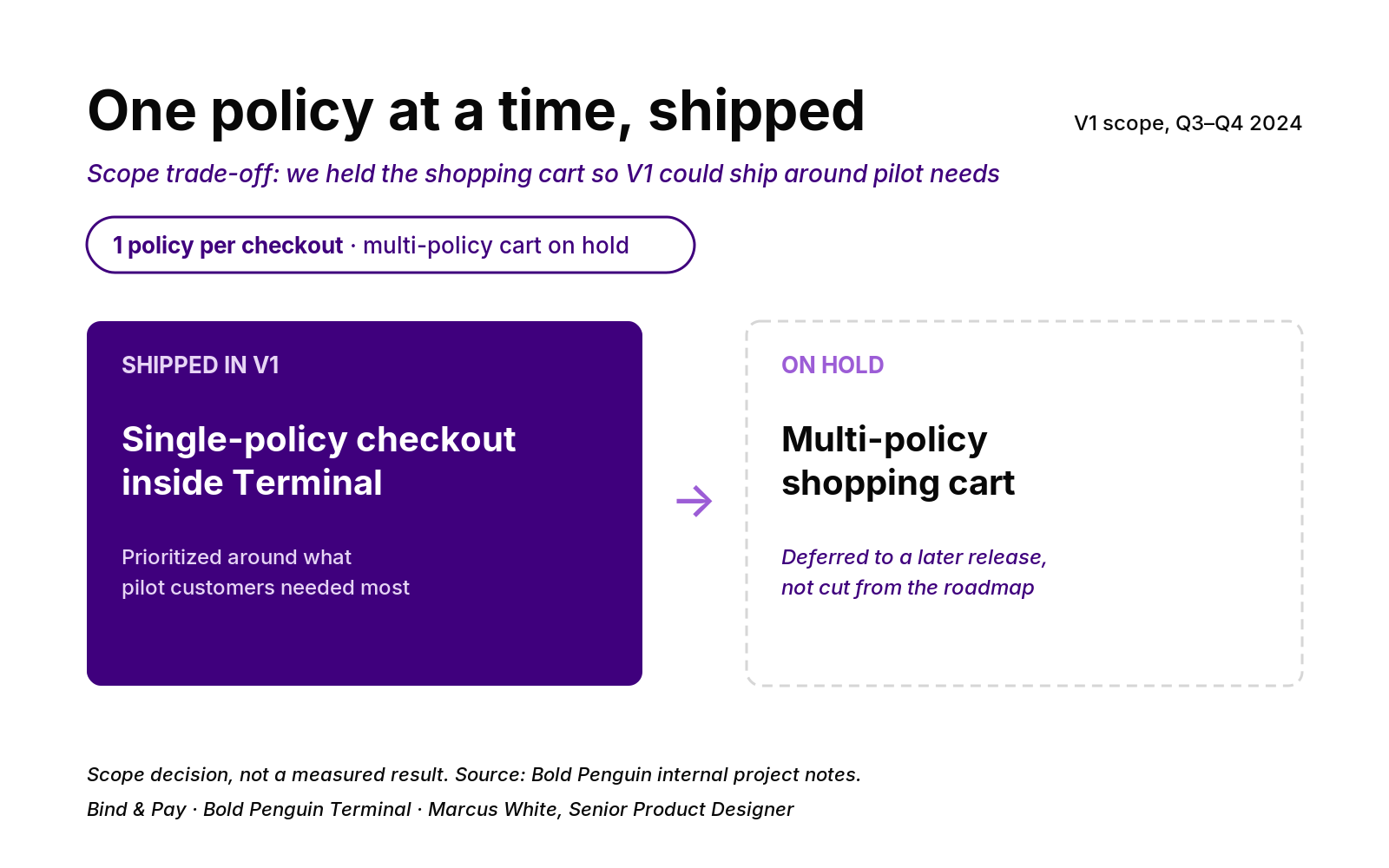
I pushed for a one-policy-at-a-time checkout in V1 so we could ship what pilot carriers needed first and hold the cart for later.
Success Metrics
The team planned to track three KPIs after launch with the business intelligence team: policies bound, Terminal conversion rate and checkout abandonment rate.
I tied the design to three planned KPIs (policies bound, Terminal conversion rate and checkout abandonment rate) so the Shelf and checkout work would be judged on binding, not just clicks.
Core solution
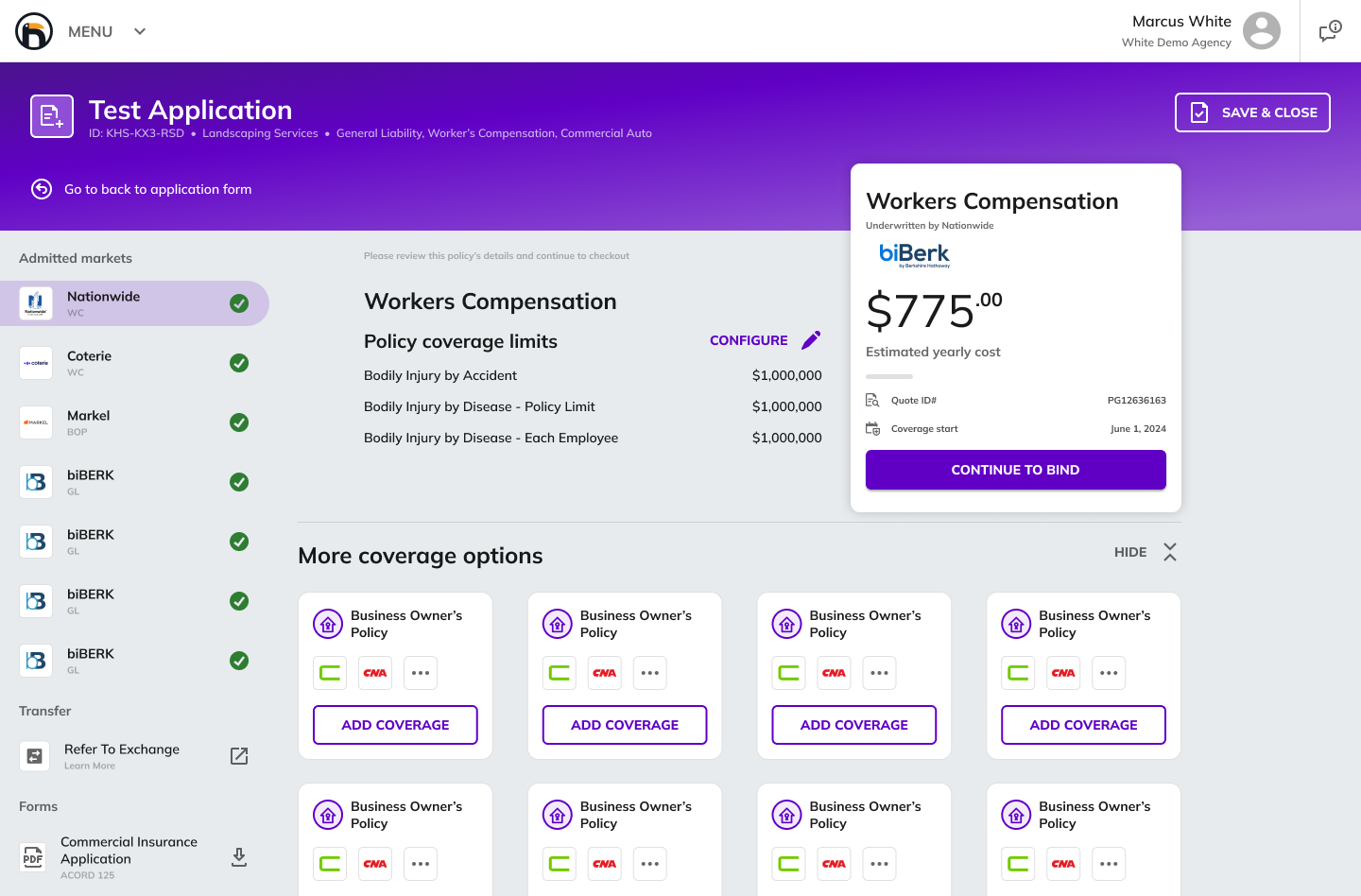
Before: quotes sat in a flat list with no clear signal of which ones an agent could bind, so the purchase step happened outside Terminal.
Before solution prototype link
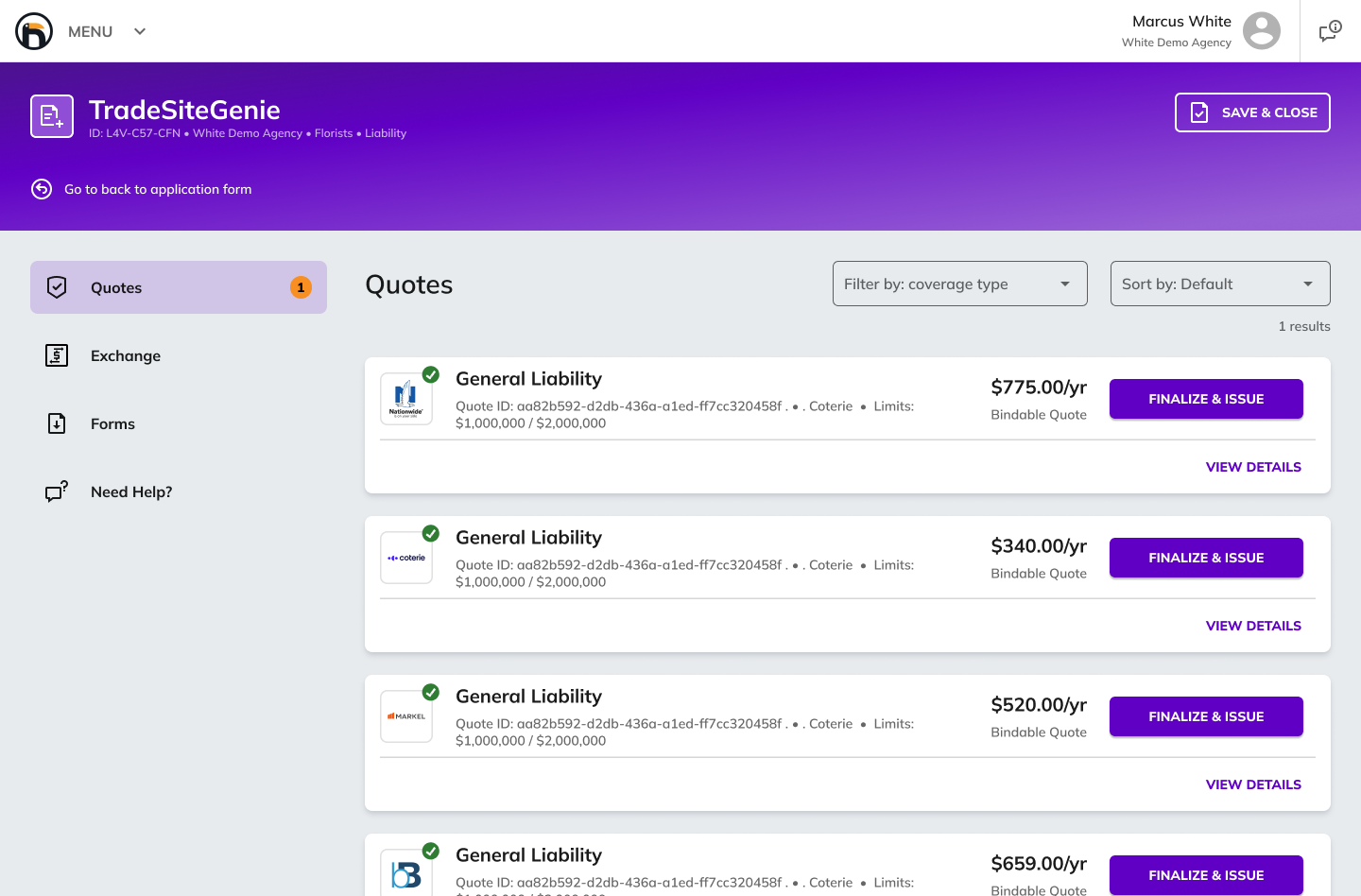
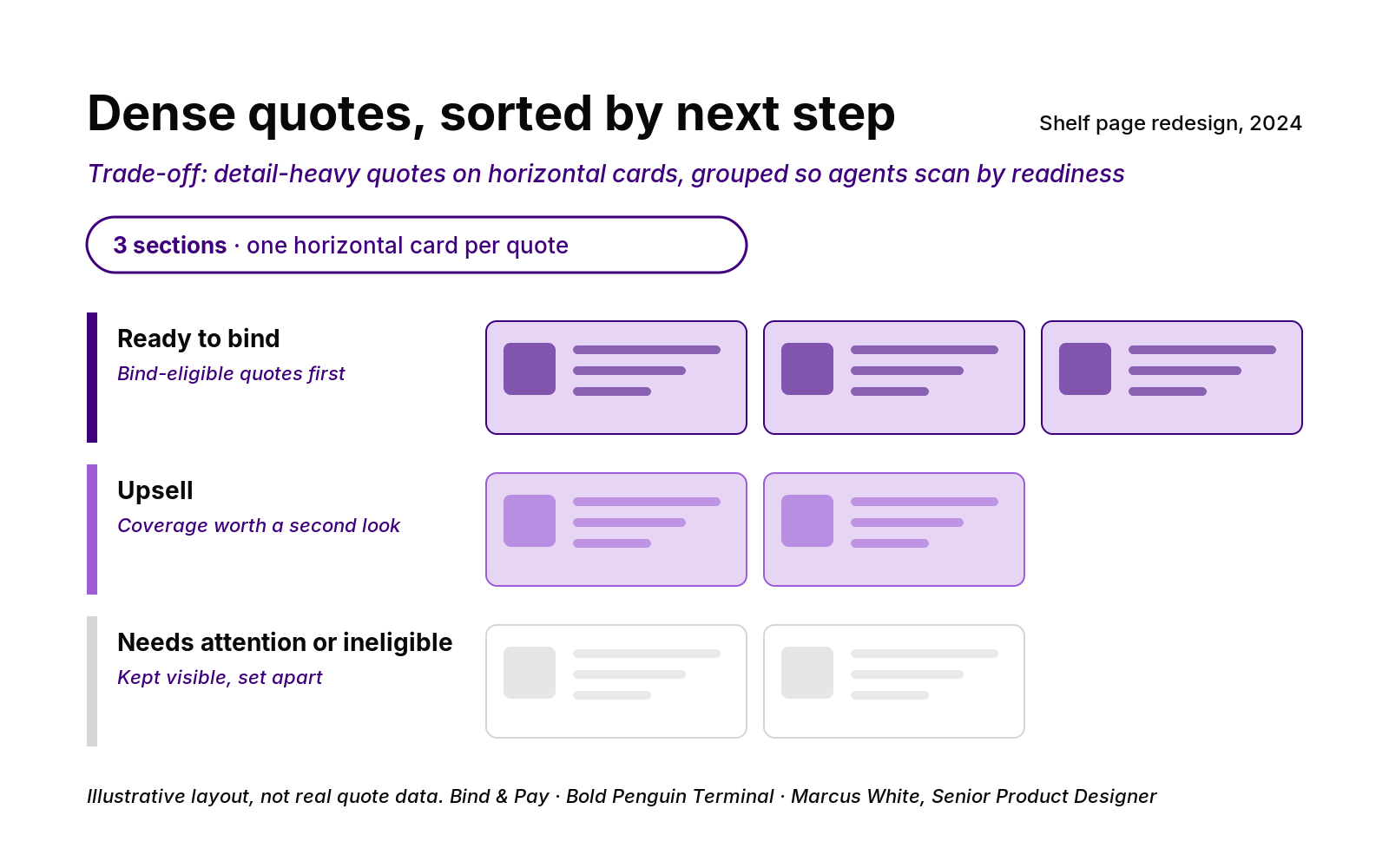
After: I redesigned the Shelf into horizontal cards grouped as ready to bind, upsell, and needs attention, which led into a checkout that handled each carrier's payment method.
After solution prototype link
Is it valuable to the customer?
Is it usable for the end-user?
Is it feasible to for engineering to build?
Is it viable for the business?
Agents stay in one tool from quote to bound policy instead of jumping between carrier portals.
Prototypes of the three carrier flows were tested in an agent feedback session. That session surfaced additional interests, payment failures on third-party pages, and document delivery for carriers without API support as gaps to solve.
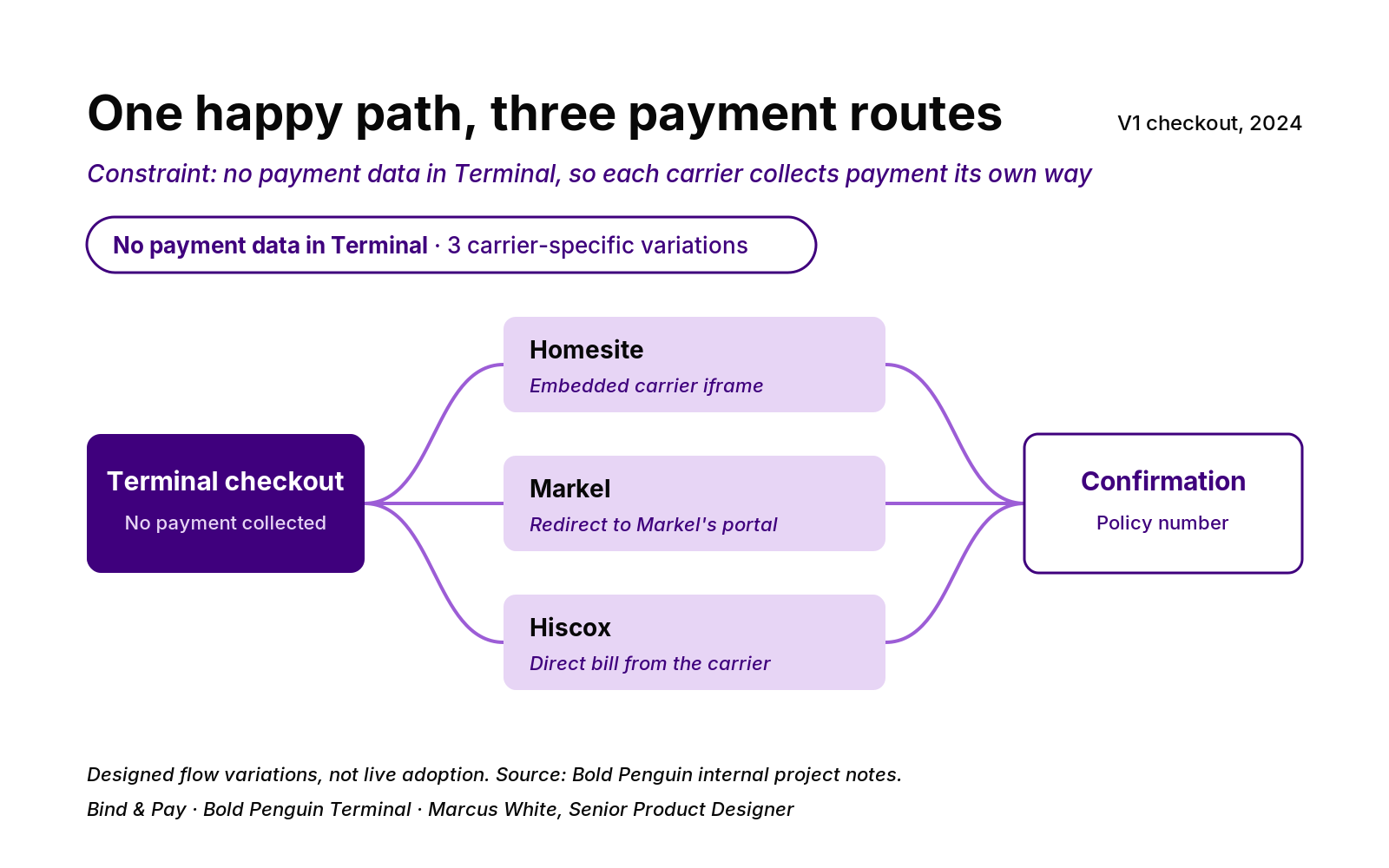
We designed around each carrier's real payment setup instead of forcing one checkout. Homesite uses an iframe overlay, Markel redirects to its portal, and Hiscox uses an iframe with direct-bill invoicing.
It fulfilled the American Family partnership commitment and created Terminal's first path to binding inside the platform.
I led the Shelf redesign and the carrier-specific payment flows, walking engineering and product through the happy path and each carrier's variation so the build matched the intent. When I handed checkout to our Lead Product Designer, I passed along the flows and the reasoning behind them so the work could keep moving without losing direction.
Evidence of impact
Bind and Pay let agents bind policies inside Terminal and finish on a confirmation page with the policy number. It piloted successfully with American Family in 2024, and GEICO and Progressive then asked for it on their panels. Bold Penguin later announced Integrated Bind with Coterie and Hiscox publicly, so agents can start, quote and bind eligible policies without leaving Terminal.
Your contribution — 1–2 sentences on how you chose benchmarks and meaningful metrics.
Constraints and tradeoffs
Scope: we put the shopping cart on hold so V1 could ship as one policy at a time, prioritized around what pilot customers needed most.
No payment data in Terminal: stakeholders ruled out collecting payment directly, so the happy path split into three carrier-specific variations.
Information density versus clarity: insurance quotes are detail-heavy, so I chose horizontal cards with three sections: ready to bind, upsell, and quotes needing attention or ineligible.
Status and next steps
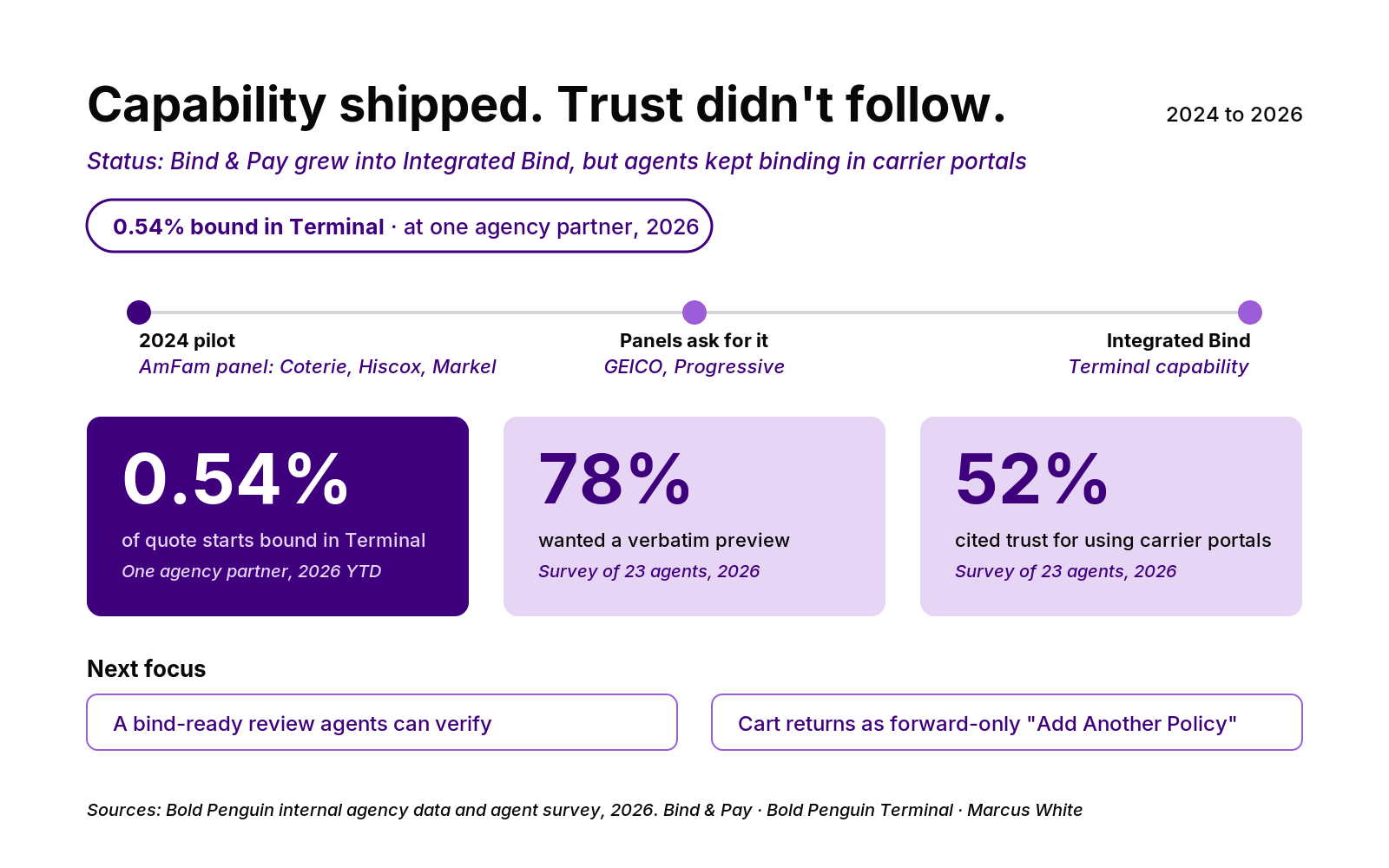
The pilot launched with American Family’s carrier panel in 2024, with Coterie, Hiscox, and Markel active. GEICO and Progressive later asked to bring Bind and Pay into their own portals, which led to Terminal’s Integrated Bind capability, now available to many carriers.
But having the capability did not mean agents used it. At one agency partner in 2026, only 0.54% of quote starts were bound inside Terminal. In a survey of 23 agents, 78% wanted a verbatim preview of exactly what would be submitted, while 52% cited trust as a reason to bind through carrier portals.
That shifted my next focus from building the purchase flow to designing a bind ready review that agents could verify. It also brought back the shopping cart we had deferred in V1 as a forward only “Add Another Policy” option.